Rihanna,
a musician who is beloved by her fans for saying and doing pretty much
whatever she wants, finally seemed to cross a line. In a cover interview
for Vanity Fair, the pop diva appeared to defend Rachel Dolezal, the white civil rights activist who claimed to be black.
Ms. Dolezal was widely shamed on social media this summer for appropriating black culture.
Rihanna’s
lengthy Vanity Fair interview centers on her dating life and being the
victim of domestic violence at the hands of her ex-boyfriend, Chris
Brown. “I will care about him until the day I die,” she said. But it was
the handful of words the singer, 27, spent on Ms. Dolezal that stuck
with fans on social media, and perhaps especially the use of the word
“hero.”
“I
think she was a bit of a hero, because she kind of flipped on society a
little bit,” Rihanna told the magazine. “Is it such a horrible thing
that she pretended to be black? Black is a great thing, and I think she
legit changed people’s perspective a bit and woke people up.”
Fans reacted with disbelief, humor and a healthy dose of memes.
Others were frustrated that someone brought Ms. Dolezal back into the spotlight.
Ms.
Dolezal, a former president of the N.A.A.C.P. chapter in Spokane,
Wash., became the subject of widespread scorn in June after her parents told the news media
that she had been pretending to be black. Her response, which she still
maintains, is that she is “transracial.” “It’s not a costume,” she told Vanity Fair in July.
In
June, Allyson Hobbs, the author of “A Chosen Exile: A History of Racial
Passing in American Life,” wrote, “at the very least, perhaps we can
use Ms. Dolezal’s story, puzzling as it is, as an opportunity to have a
candid, lively, long-delayed, public conversation about the knotty
meanings of race and racial identity, and how it has confounded our
nation’s best aspirations.”
Those who saw Ms. Dolezal’s behavior as a harmful violation were more vocal.
“In
this moment, when blackness means something very specific — asserting
that black lives matter — it follows for many people that categorical
clarity has to matter, too,” Daniel J. Sharfstein, who wrote “The
Invisible Line: A Secret History of Race in America,” wrote in the The New York Times Magazine in June.
On Tuesday, this was the view that resurfaced.
“Sure, being black is great,” Yesha Callahan wrote
in The Root, picking up on what the pop star said. “I’m great every
day. But as a white person, lying about being black isn’t anything
great, but more a fraud. Dolezal couldn’t be anything further away from
the term ‘hero.’ ”
Every
year, an American comedian receives a serious award -- and not just for
being very funny. On Sunday, this year's Mark Twain Prize for American
Humor went to Eddie Murphy.
"The
Mark Twain Prize recognizes people who have had an impact on American
society in ways similar to the distinguished 19th century novelist and
essayist best known as Mark Twain," said the John F. Kennedy Center for
the Performing Arts in its description of the prize.
The
prize, first awarded in 1998 to Richard Pryor, highlights social
criticism and insightful observation brought out by humor. Among
previous recipients are Jonathan Winters, Lily Tomlin, Will Ferrell and
Ellen DeGeneres.
"I am deeply
honored to receive this recognition from the Kennedy Center and to join
the distinguished list of past recipients of this award," Murphy said
according to a statement from the Kennedy Center.
"It's
going to be great!" the comedian posted to his official Facebook feed
before the ceremony. The post included a picture of Mark Twain with a
quote: "It's easier to fool people than to convince them that they have
been fooled."
He treated the audience to a standup routine, something he has reportedly not done in many years.
Murphy is the highest-earning ever African American screen actor, the Kennedy Center said. But he got his start in standup.
Teen success
At age 15, he worked clubs in New York with celebrity impressions, according to his biography on the Internet Movie Database. He may have inherited the talent from his father, a transit police officer who acted and performed standup himself.
At
age 19, Murphy landed a cast roll on Saturday Night Live, and like many
Not Ready for Prime Time Players -- as its actors were called in the
shows early years -- he rocketed into a movie career in the 1980s that
has continues to the present day.
He has commanded fees of up to $20,000,000 per movie role, according to IMDb.
One
of Murphy's earliest movies, "Beverly Hills Cop," in 1984, cast him in
the recurring role of Detective Alex Foley -- and there are plans to
produce a fourth movie in the series.
Murphy also does the voice of Donkey in the "Shrek" movies.
She has led armies, conquered cities and ridden dragons.
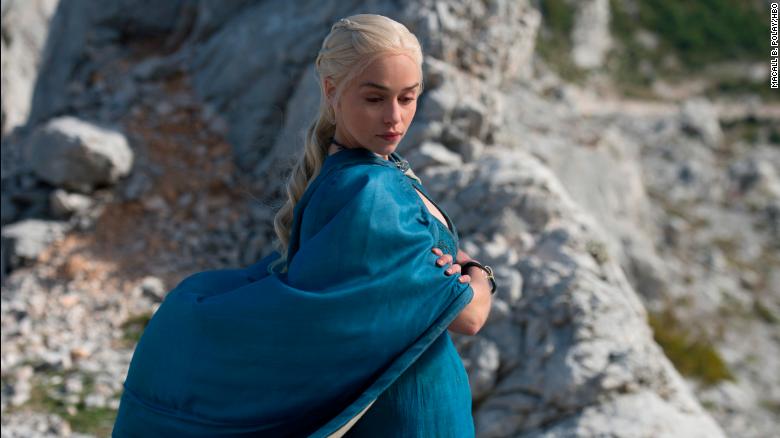
And now "Game of Thrones'" Emilia Clarke is the sexiest woman alive, according to Esquire.
The
men's magazine bestowed its annual honor on the British actress, 28,
who plays aspiring queen Daenerys Targaryen on the hit HBO show. Clarke
appears half-clothed on the cover of Esquire's November issue and in various states of undress inside the magazine, which compliments her ability to play both "friendly and fierce" onscreen.
Clarke tells Esquire she had to look up the "Game of Thrones" series online before auditioning for the role.
"I
had two scenes which told me nothing and not very much time in which to
read all those (George R.R. Martin) books," she says. "So I did what
every good actor does and Wikipedia'd the living crap out of it."
British actress Emilia Clarke appears on the cover of the November issue of Esquire.
Over
the show's five seasons, Clarke's character survives an arranged
marriage to a primitive warrior, betrayal by one of her trusted
lieutenants and repeated challenges to her growing power. Her nuanced
portrayal of the golden-tressed Daenerys, revealing both strength and
vulnerability, has won her two Emmy nominations.
The
role also required her to do several difficult sex and nude scenes,
including one in which she appears to be violated by her new husband on
their wedding night.
"Once, I had to
take a little time out," she says. "I said I needed a cup of tea, had a
bit of a cry, and was ready for the next scene."
Clarke follows Penelope Cruz and Scarlett Johansson as past recipients of Esquire's "Sexiest Woman Alive" title.
A Plymouth teenager has revealed how he made £21.2m in less than 12 months on the financial markets – but still shops at Lidl.
Sam Cook, 18, started with a £2,000 loan from
his father, Peter, last February. An amazing run of fortune saw him
make £6m in one day last summer, trading across currency, stock and
commodities markets on V8Options trading
platform. Sam has dyslexia and struggled at school, leaving Kelly
College, Tavistock, with two GCSEs. He splashed £170,000 on a Ferrari
and a £12,000 watch but says he is ‘tight’ with money. Sam says he has
no plans to quit while he is ahead.
“I want to have £2billion by the time I am
50,” he said. Sam, in his dad’s jumper, wearing a pair of charity shop
trousers and sipping a glass of water in a city cafe, made his latest
wins last week gambling on currency. He gambled on the Euro dropping
against the US Dollar, and won. Then he gambled on the European currency
recovering – and won again. Ker-ching: another £1.5m in the till in a
matter of days. Despite his casual appearance today, Sam has splashed
some cash. He had a holiday in Barbados, and bought luxury watches and a
bright red Ferrari F430 Scuderia. “It’s worth £170,000 – but I paid
£135,000.”
That sums him up: he clearly has a gift for
making money; he also has an eye for a bargain. His shop of choice is a
budget supermarket. “I like a nice hotel and fine dining – you get your
money’s worth out of that – but I’m not into designer clothes and I
don’t waste money. I don’t believe in paying more than you need to. I
shop at Lidl.”
One amazing day in July 2014 Sam had been
watching the growing volatility across the markets due to the sanctions
against Russian over political interference in Ukraine. “I did 29
different trades, some that certain prices would rise, others on prices
to fall. I was lying on the beach at Crantock and my phone was bleeping.
Every trade was going the right way. It did not feel real. I felt there
must be something wrong. The family promptly left the beach so Sam
could go on to his computer at home. It was all right. I’d made £6
million. I felt a bit sick. I could not believe it.”
Sam is careful about making friends since he
got his fortune. He and girlfriend Evelyn Simpson, 25, got to know each
other before he revealed his secret. “I wanted to make sure she was not
there for the money,” he admits.
“The more money you have, the more you can
make. If you make five per cent on £23,000, what’s that? £1,150. If you
make five per cent on £6m that’s £300,000.”
As his money has grown, Sam has allowed
himself some luxuries. He has enough high-end watches to wear on each
day of the week. His favourite is a Cartier studded with pink diamonds,
worth £120,000. “I do like my watches,” he says, adding quickly: “They
are an investment. They won’t go down in value.”
His father, Peter, is still cautious about
his son’s achievements. “I’ve always had a slight interest in stocks and
shares,” says Peter, 49. “Sam started asking me questions so I
explained about ‘Mr Kenco’ and ‘Mr Nescafe’ and told him about how the
price of coffee changed with harvests and demand and the rest of it.”
Sam, then 15, was still at school and dabbled in the markets, but only
with a dummy account where he could win – or lose – points rather than
money. The casual interest would later develop into an obsession when he
had more experience of the world and had done his research. He was at
fee-paying Kelly College, Tavistock, at the time.
“I never excelled at exams. I hated being
cooped up in a classroom. Learning Support was alright, more relaxed. I
was put in there because I didn’t listen. I was always thinking about
ways to make money. About ten minutes before the end the lesson I’d ask
to go to the toilet. I’d go to the tuck machine and buy up most of the
favourite sweets. When the lesson ended there’d be a big queue. The ones
at the back knew they wouldn’t get what they wanted, so I’d go round
selling them at a pretty price.” Basic economics. “Demand and supply,”
he grins.
At the back of his mind, though, was the
thought of making money on the markets covering stock, currency and
commodities (resources such as minerals and agricultural products such
as sugar and coffee). “I did a lot of research and studied how they were
connected. I knew a lot more about the world. My dad let me borrow
£2,000 last February to trade on V8Options. Every time I made money, I put it back in and made more.”
Sam is there for the money – and the long
term. “I want to have £2billion by the time I am 50. You could really do
something with that amount of money. I’d get more satisfaction giving
that away than buying things like Ferraris. I’d like to build some
schools if Africa, maybe a refuge for former child soldiers.”
For now, though, he has other business to
attend to. “I have to go pick up my girlfriend. She’s shopping at Lidl.
You should see people’s faces when they see a Ferrari in the car park.
My advice to anyone who wants to be the main man and not a bystander in
life. Learn to trade. Work hard and fast. The more you risk, the more you can gain. Play it safe, you can still gain, but it’ll take a lot longer.”
The
2015 American Music Awards announced its nominations Tuesday, and the
familiar name of Taylor Swift was once again atop the list.
Swift
earned six AMA nominations, including nods for artist of the year, song
of the year ("Blank Space") and "collaboration of the year unleashed by
T-Mobile," as the AMAs call it. The latter was for "Bad Blood," her
pairing with Kendrick Lamar.
Right
behind Swift, with five nominations each, were The Weeknd and Ed
Sheeran. Both had songs in the song of the year category: The Weeknd
with "Can't Feel My Face" and Sheeran with "Thinking Out Loud."
Both are also part of the expansive artist of the year category, which includes 10 artists, all told.
Other
artist of the year nominees are Luke Bryan, Ariana Grande, Maroon 5,
Nicki Minaj, One Direction, Sam Smith and Meghan Trainor.
The
AMAs made clever use of social media in announcing the nominations. Six
categories were broadcast live on ABC's "Good Morning America,"
followed by five more categories announced via Snapchat. The remaining
12 categories were livestreamed by ABC News.
Fans
will be allowed to vote on AMAvote.com, posting on Facebook with a
nominee's name and category hashtag or posting on Twitter with a
nominee's name, the category name and the #AMA hashtag.
The show airs November 22 on ABC. Jennifer Lopez is hosting.
The
AMAs, which were created by Dick Clark in 1973, based the nominations
on "key fan interactions as reflected in Billboard Magazine and on
Billboard.com, including album and digital singles sales, radio airplay,
streaming, social activity and touring," according to a statement.
Mark
Bowden was watching a ballgame — the Phillies versus the Mets — on the
night of May 1, 2011, when the network cut away to President Obama in
the East Room of the White House. “Tonight,” the president said, ‘‘I can
report to the American people and to the world that the United States
has conducted an operation that killed Osama bin Laden, the leader of Al
Qaeda and a terrorist who’s responsible for the murder of thousands of
innocent men, women and children.’’
Five
minutes or so after the president wrapped up his brief remarks, as
thousands of Americans gathered in front of the White House and at
ground zero chanting ‘‘U-S-A! U-S-A!’’ Bowden’s cellphone rang. It was
Mike Stenson, the president of Jerry Bruckheimer Films. Bowden had
worked with Bruckheimer on the film adaptation of his 1999 best seller,
‘‘Black Hawk Down.’’
‘‘Mike
said, ‘Look, Mark, Jerry wants to make a movie about this bin Laden
thing, and he wants to put together all of the people who made ‘Black
Hawk Down,’ ’’ Bowden told me over lunch recently. ‘‘ ‘He wants to know:
Would you be willing to write the script?’ ’’
Bowden said absolutely, count him in.
He
quickly reached out to Jay Carney, Obama’s press secretary at the time,
to ask for an interview with the president. Bowden was friendly with
Carney from a profile he wrote of Vice President Joseph R. Biden Jr. for
The Atlantic. Still, he was surprised to hear back from him almost
right away. It was an encouraging response, especially given the deluge
of requests Bowden knew the president must be receiving. Carney said
that he couldn’t make any promises but that he would definitely advocate
on his behalf.
The next day, Stenson called back: Bruckheimer had changed his mind.
Bowden
considered for a second and decided he would write a book instead. In
some ways, it was a perfect match of author and subject. Bowden
specializes in chronicling covert operations. In addition to ‘‘Black
Hawk Down,’’ which told the story of a 1993 raid in Somalia by U.S. Army
Rangers and Delta Force teams that went disastrously awry, he has
written books about the failed mission to rescue the American hostages
in Iran in 1980 and the long manhunt for the Colombian drug kingpin
Pablo Escobar.
His
method in those books was to combine exhaustive reporting with vivid
storytelling. It helps that Bowden tends to write about historical
events a long time after they take place. People are typically eager to
sit down with him, and they are usually able to speak freely. One
interview subject leads to another, who leads to another, and so on.
It’s a process that can take years.
The
bin Laden book proved to be a very different sort of undertaking.
Bowden was trying to tell the story just months after it happened. And
only a small number of people — a handful of senior administration and
military officials and the Navy SEALs who carried out the operation —
had been privy to the events of that evening. There was virtually no
paper trail for Bowden to follow; the government had classified all the
documents relating to the raid, including the record of the C.I.A.’s
search for bin Laden. Bowden had to request interviews through official
administration channels and hope for the best.
His
book, ‘‘The Finish,’’ was published in the fall of 2012, and the story
it tells is one that is by now familiar. The C.I.A., working in the
shadows for many years, had identified a courier whom agency officers
eventually traced to a large compound in Abbottabad, Pakistan. Agents
studied this compound for months via distant satellite cameras but
couldn’t be certain that bin Laden was inside. If he was — a 55/45
percent proposition, Obama said later — the president did not want to
let him slip away. The safe play was to reduce the compound to dust with
a bomb or missiles, but this would risk civilian casualties and also
make it impossible to verify the kill with any certainty. Obama instead
sent in a team of 23 Navy SEALs in two Black Hawk helicopters. The whole
mission almost fell apart when one of the helicopters had to crash-land
near an animal pen inside the compound. But the SEALs adapted on the
fly and were soon making their assault, breaching gates and doors with
C-4 charges and, eventually, killing their target. Before leaving, they
blew up the damaged Black Hawk. As they flew off, a giant fire raged
inside the compound. The Pakistani government was none the wiser until
the SEALs were long gone.
This
irresistible story would be told in many different forms in the months
and years that followed. Bowden’s was one of several books, but there
were also countless newspaper articles, magazine features, television
news programs and ultimately the 2012 movie ‘‘Zero Dark Thirty,’’ which
billed itself as the narrative of ‘‘the Greatest Manhunt in History.’’
In this sense, the killing of bin Laden was not only a victory for the
U.S. military but also for the American storytelling machine, which
kicked into high gear pretty much the moment the terrorist leader’s dead
body hit the floor.
Last
spring, Bowden got another unexpected call on his cellphone. He was on
his way home to Pennsylvania from a meeting in New York with his
publisher about his next book, the story of the Battle of Hue in the
Vietnam War. On the other end of the line was Seymour Hersh, the
investigative reporter.
Hersh
was calling to ask about the photographs of bin Laden’s burial at sea —
carried out, the U.S. government said, in accordance with Islamic
custom — that Bowden had described in detail at the end of ‘‘The
Finish,’’ as well as in an adaptation from the book that appeared in Vanity Fair.
‘‘One frame shows the body wrapped in a weighted shroud,’’ Bowden had
written. ‘‘The next shows it lying diagonally on a chute, feet
overboard. In the next frame, the body is hitting the water. In the next
it is visible just below the surface, ripples spreading outward. In the
last frame there are only circular ripples on the surface. The mortal
remains of Osama bin Laden were gone for good.’’
Hersh wanted to know: Had Bowden actually seen those photos?
Bowden told Hersh that he had not. He explained that they were described to him by someone who had.
Hersh
said the photographs didn’t exist. Indeed, he went on, the entire
narrative of how the United States hunted down and killed bin Laden was a
fabrication. He told Bowden that he was getting ready to publish the
real story of what happened in Abbottabad.
Bowden
said he found Hersh’s claims hard to believe. Hersh tried to
sympathize. ‘‘Nobody likes to get played,’’ he said, adding that he
meant no offense.
‘‘I
said, ‘No offense taken,’ ’’ Bowden recalled. ‘‘I told him that he was,
after all, Seymour Hersh, and that he ought to do whatever he thought
best. But that in this case, I feared he was mistaken.’’
It’s hard to
overstate the degree to which the killing of Osama bin Laden
transformed American politics. From a purely practical standpoint, it
enabled Obama to recast himself as a bold leader, as opposed to an
overly cautious one, in advance of his 2012 re-election campaign. This
had an undeniable impact on the outcome of that election. (‘‘Osama bin
Laden is dead and General Motors is alive,’’ Joe Biden was fond of
boasting on the campaign trail.) Strategically, the death of bin Laden
allowed Obama to declare victory over Al Qaeda, giving him the cover he
needed to begin phasing U.S. troops out of Afghanistan. And it almost
single-handedly redeemed the C.I.A., turning a decade-long failure of
intelligence into one of the greatest triumphs in the history of the
agency.
But
bin Laden’s death had an even greater effect on the American psyche.
Symbolically, it brought a badly wanted moment of moral clarity, of
unambiguous American valor, to a murky war defined by ethical compromise
and even at times by collective shame. It completed the historical arc
of the 9/11 attacks. The ghastly image of collapsing towers that had
been fixed in our collective minds for years was dislodged by one of
Obama and his senior advisers huddled tensely around a table in the
White House Situation Room, watching closely as justice was finally
brought to the perpetrator.
The first dramatic reconstruction of the raid itself — ‘‘Getting bin Laden: What Happened That Night in Abbottabad’’
— was written by a freelancer named Nicholas Schmidle and published in
The New Yorker just three months after the operation. The son of a
Marine general, Schmidle spent a couple of years in Pakistan and has
written on counterterrorism for many publications, including this
magazine. His New Yorker story was a cinematic account of military
daring, sweeping but also granular in its detail, from the ‘‘metallic
cough of rounds being chambered’’ inside the two Black Hawks as the
SEALs approached the compound, to the mud that ‘‘sucked at their boots’’
when they hit the ground. One of the SEALs who shot bin Laden, Matt
Bissonnette, added a more personal dimension to the story a year later
in a best-selling book, ‘‘No Easy Day.’’ Bowden focused on Washington,
taking readers inside the White House as the president navigated what
would become a defining moment of his presidency. And then there was
‘‘Zero Dark Thirty,’’ which chronicled the often barbaric C.I.A.
interrogations that the agency said helped lead the United States to bin
Laden’s compound.
Photo
Credit
Illustration by Javier Jaén
The
official narrative of the hunt for and killing of bin Laden at first
seemed like a clear portrait, but in effect it was more like a composite
sketch from multiple perspectives: the Pentagon, the White House and
the C.I.A. And when you studied that sketch a little more closely, not
everything looked quite right. Almost immediately, the administration
had to correct some of the most significant details of the raid. Bin
Laden had not been ‘‘engaged in a firefight,’’ as the deputy
national-security adviser, John Brennan, initially told reporters; he’d
been unarmed. Nor had he used one of his wives as a human shield. The
president and his senior advisers hadn’t been watching a ‘‘live feed’’
of the raid in the Situation Room; the operation had not been captured
on helmet-cams. But there were also some more unsettling questions about
how the whole story had been constructed. Schmidle acknowledged after
his article was published that he had never actually spoken with any of
the 23 SEALs. Some details of Bissonnette’s account of the raid
contradicted those of another ex-SEAL, Robert O’Neill, who claimed in Esquire
and on Fox News to have fired the fatal bullet. Public officials with
security clearances told reporters that the torture scenes that were so
realistically depicted in ‘‘Zero Dark Thirty’’ had not in fact played
any role in helping us find bin Laden.
Then
there was the sheer improbability of the story, which asked us to
believe that Obama sent 23 SEALs on a seemingly suicidal mission,
invading Pakistani air space without air or ground cover, fast-roping
into a compound that, if it even contained bin Laden, by all rights
should have been heavily guarded. And according to the official line,
all of this was done without any sort of cooperation or even assurances
from the Pakistani military or intelligence service. How likely was
that? Abbottabad is basically a garrison town; the conspicuously large
bin Laden compound — three stories, encircled by an 18-foot-high
concrete wall topped with barbed wire — was less than two miles from
Pakistan’s equivalent of West Point. And what about the local police?
Were they really unaware that an enormous American helicopter had
crash-landed in their neighborhood? And why were we learning so much
about a covert raid by a secret special-operations unit in the first
place?
American
history is filled with war stories that subsequently unraveled.
Consider the Bush administration’s false claims about Saddam Hussein’s
supposed arsenal of weapons of mass destruction. Or the imagined attack
on a U.S. vessel in the Gulf of Tonkin. During the Bay of Pigs, the
government inflated the number of fighters it dispatched to Cuba in
hopes of encouraging local citizens to rise up and join them. When the
operation failed, the government quickly deflated the number, claiming
that it hadn’t been an invasion at all but rather a modest attempt to
deliver supplies to local guerrillas. More recently, the Army reported
that the ex-N.F.L. safety Pat Tillman was killed by enemy fire, rather
than acknowledging that he was accidentally shot in the head by a
machine-gunner from his own unit.
These
false stories couldn’t have reached the public without the help of the
media. Reporters don’t just find facts; they look for narratives. And an
appealing narrative can exert a powerful gravitational pull that winds
up bending facts in its direction. During the Iraq war, reporters
informed us that a mob of jubilant Iraqis toppled the statue of Saddam
Hussein in Firdos Square. Never mind that there were so few local people
trying to pull the statue down that they needed the help of a U.S.
military crane. Reporters also built Pvt. Jessica Lynch into a war hero
who had resisted her captors during an ambush in Iraq, when in fact her
weapon had jammed and she remained in her Humvee. In an Op-Ed essay in The Times
about the Lynch story in 2003, it was Bowden himself who explained this
phenomenon as ‘‘the tendency to weave what little we know into a
familiar shape — often one resembling the narrative arc of a film.’’
Was
the story of Osama bin Laden’s death yet another example of American
mythmaking? Had Bowden and, for that matter, all of us been seduced by a
narrative that was manufactured expressly for our benefit? Or were
these questions themselves just paranoid?
‘‘The story stunk
from Day 1,’’ Hersh told me. It was a miserably hot summer day in
Washington, and we were sitting in his office, a two-room suite in an
anonymous office complex near Dupont Circle, where Hersh works alone.
There’s no nameplate on the door; the walls of the anteroom are crowded
with journalism awards. ‘‘I have a lot of fun here,’’ he said, amid the
clutter of cardboard boxes and precariously stacked books. ‘‘I can do
whatever I want.’’
Within
days of the bin Laden raid, Hersh told me, ‘‘I knew there was a big
story there.’’ He spent the next four years, on and off, trying to get
it. What he wound up publishing, this May in The London Review of Books,
was no incremental effort to poke a few holes in the administration’s
story. It was a 10,000-word refutation
of the entire official narrative, sourced largely to a retired U.S.
senior intelligence official, with corroboration from two ‘‘longtime
consultants to the Special Operations Command.’’ Hersh confidently
walked readers through an alternate version of all the familiar plot
points in a dispassionate, just-the-facts tone, turning a story of
patient perseverance, careful planning and derring-do into one of luck
(good and bad), damage control and opportunism.
Hersh,
who is 78, was reluctant to cooperate when I told him that I was
interested in writing about his article. (‘‘I’ve gotta bunch of problems
with your request,’’ his first email to me began.) He wanted me to
follow up on his reporting instead and suggested that I might start by
looking into Pakistan’s radar system, which he said was far too
sophisticated to allow two U.S. helicopters to enter the country’s
airspace undetected. (‘‘Those dimwitted third-world guys just can’t get
anything right,’’ he wrote sarcastically, meaning of course the
Pakistanis would have been aware of two military helicopters flying
into the heart of their country.) Hersh, who worked at The New York
Times for seven years in the 1970s, didn’t think the paper would allow
me to take his claims seriously. ‘‘If you did so,’’ he wrote, ‘‘you
better be sure not to let your wife start the car for the next few
months.’’ But after a little prodding, he relented and spent the better
part of a day with me, describing his reporting as thoroughly as he felt
he could without compromising his sources.
Hersh’s
most consequential claim was about how bin Laden was found in the first
place. It was not years of painstaking intelligence-gathering, he
wrote, that led the United States to the courier and, ultimately, to bin
Laden. Instead, the location was revealed by a ‘‘walk-in’’ — a retired
Pakistani intelligence officer who was after the $25 million reward that
the United States had promised anyone who helped locate him. For that
matter, bin Laden was hardly ‘‘in hiding’’ at all; his compound in
Abbottabad was actually a safe house, maintained by the Pakistani
intelligence service. When the United States confronted Pakistani
intelligence officials with this information, Hersh wrote, they
eventually acknowledged it was true and even conceded to provide a DNA
sample to prove it.
According
to Hersh’s version, then, the daring raid wasn’t especially daring. The
Pakistanis allowed the U.S. helicopters into their airspace and cleared
out the guards at the compound before the SEALs arrived. Hersh’s
sources told him the United States and Pakistani intelligence officials
agreed that Obama would wait a week before announcing that bin Laden had
been killed in a ‘‘drone strike somewhere in the mountains on the
Pakistan/Afghanistan border.’’ But the president was forced to go public
right away, because the crash and subsequent destruction of the Black
Hawk — among the rare facts in the official story that Hersh does not
dispute — were going to make it impossible to keep the operation under
wraps.
As
if those assertions weren’t significant enough, Hersh went on to make
some even wilder claims. He wrote, for instance, that bin Laden had not
been given a proper Islamic burial at sea; the SEALs threw his remains
out of their helicopter. He claimed not just that the Pakistanis had
seized bin Laden in 2006, but that Saudi Arabia had paid for his upkeep
in the years that followed, and that the United States had instructed
Pakistan to arrest an innocent man who was a sometime C.I.A. asset as
the fall guy for the major in the Pakistani Army who had collected bin
Laden’s DNA sample.
What
was perhaps most shocking of all, though, was that this elaborate
narrative was being unspooled not by some basement autodidact but by one
of America’s greatest investigative reporters, the man who exposed the
massacre of hundreds of Vietnamese civilians in the village of My Lai
(1969), who revealed a clandestine C.I.A. program to spy on antiwar
dissidents (1974) and who detailed the shocking story of the abuses at
Abu Ghraib (2004). Could the bin Laden article be another major Hersh
scoop?
‘‘It’s
always possible,’’ Bowden told me. ‘‘But given the sheer number of
people I talked to from different parts of government, for a lie to have
been that carefully orchestrated and sustained to me gets into
faked-moon-landing territory.’’ Other reporters have been less generous
still. ‘‘What’s true in the story isn’t new, and what’s new in the story
isn’t true,’’ said Peter Bergen of CNN, who wrote his own best-selling
account of the hunting and killing of bin Laden, ‘‘Manhunt.’’ And
government officials were least receptive of all. Josh Earnest, then the
White House spokesman, said Hersh’s ‘‘story is riddled with
inaccuracies and outright falsehoods.’’ Col. Steve Warren, a Pentagon
spokesman, said it was ‘‘largely a fabrication.’’ (There were ‘‘too many
inaccuracies to even bother going through them line by line.’’) The
administration pretty much left it at that, though some of Hersh’s
critics have pointed to classified documents made public by Edward
Snowden revealing a long history of C.I.A. surveillance of the
Abbottabad compound as proof that its location hadn’t simply been
revealed by a walk-in.
This
sort of reception is nothing new for Hersh. A Pentagon spokesman at the
time of Abu Ghraib, Lawrence Di Rita, described one of his many (now
unchallenged) articles for The New Yorker on the scandal as ‘‘the most
hysterical piece of journalist malpractice I have ever observed.’’
Still, Hersh got worked up in some of the interviews he gave after the
publication of the bin Laden piece. ‘‘I don’t care if you don’t like my
story!’’ he told a public-radio host during one grilling. ‘‘I don’t
care!’’ But with time, his petulance cooled into a kind of amusement.
‘‘High-camp’’ was one adjective he used to describe the administration’s
version of the events.
At
one point in our conversation, I reminded Hersh that I wasn’t going to
offer a definitive judgment on what happened. I didn’t want to
reinterview the administration officials who had already given their
accounts of the events to other journalists. I saw this as more of a
media story, a case study in how constructed narratives become accepted
truth. This felt like a cop-out to him, as he explained in a long email
the next day. He said that I was sidestepping the real issue, that I was
‘‘turning this into a ‘he-said, she-said’ dilemma,’’ instead of coming
to my own conclusion about whose version was right. It was then that he
introduced an even more disturbing notion: What if no one’s version
could be trusted?
‘‘Of
course there is no reason for you or any other journalist to take what
was said to me by unnamed sources at face value,’’ Hersh wrote. ‘‘But it
is my view that there also is no reason for journalists to take at face
value what a White House or administration spokesman said on or off the
record in the aftermath or during a crisis.’’
For those in
and around the news business, the fact that Hersh’s report appeared in
The London Review of Books and not The New Yorker, his usual outlet, was
a story in its own right, one that hasn’t been told in full before.
(Editors and reporters may not be as secretive as intelligence
officials, but they like to keep a tight lid on their operational
details, too.)
A week or so after the raid, Hersh called The New Yorker’s editor, David Remnick. In 2009, Hersh wrote a story for the magazine
about the growing concern among U.S. officials that Pakistan’s large
nuclear arsenal could fall into the hands of extremists inside the
country’s military. Now he let Remnick know that two of his sources —
one in Pakistan, the other in Washington — were telling him something
else: The administration was lying about the bin Laden operation.
One
of The New Yorker’s staff writers, Dexter Filkins, was already planning
a trip to Pakistan for a different assignment. It is rare, but not
unprecedented, for The New Yorker to run double-bylined articles, and
the magazine decided to pursue one. It paired Filkins with Hersh, asking
Filkins to report the Pakistani side — in particular, the notion that
Pakistan had secretly cooperated with the United States — while Hersh
would keep following leads from Washington. But Filkins, who covered
Afghanistan and Pakistan for The Times before moving to The New Yorker,
spent about a week running the tip by sources inside the Pakistani
government and military with little success.
‘‘It
wasn’t even that I was getting angry denials,’’ Filkins told me. ‘‘I
was getting blank stares.’’ Filkins said the mood on the ground
completely contradicted Hersh’s claim; the Pakistani military seemed
humiliated about having been kept in the dark by the Americans. Remnick
told him to move on. He ended up writing about a Pakistani journalist
who was murdered, probably by the country’s intelligence service, the
I.S.I., after detailing the links between Islamist militants and the
Pakistani military.
In
the meantime, The New Yorker published Schmidle’s account of the bin
Laden raid, and, soon after, brought Schmidle on as a staff writer. (In
an email, Schmidle told me his subsequent reporting has only confirmed
his initial account. Regarding the possibility ‘‘that some inside the
Pakistani military or intelligence services knew that bin Laden was
living in that house, I think it’s entirely plausible, though I’ve not
seen any proof,’’ he wrote.)
Hersh
plowed ahead by himself, working his sources, trying to flesh out his
counternarrative. Three years later he sent a draft to The New Yorker.
After reading it a few times, Remnick told Hersh that he didn’t think he
had the story nailed down. He suggested that Hersh continue his
reporting and see where it took him. Instead, Hersh gave the story to
The London Review of Books.
Hersh
has never been on The New Yorker’s staff, preferring to remain a
freelancer. But he has strong ties to the magazine. He published his
first article there in 1971 and has written hundreds of thousands of
words for the magazine since then, including, most recently, an essay about visiting My Lai
with his family that was published only weeks before his London Review
of Books article on bin Laden. (His son Joshua, now a reporter for
Buzzfeed, was a New Yorker fact-checker for many years.) Remnick has
published some of Hersh’s most provocative articles and, for that
matter, plenty of other major national-security stories that the
government would have preferred to keep buried.
But
the bin Laden report wasn’t the first one by Hersh that Remnick
rejected because he considered the sourcing too thin. In 2013 and 2014,
he passed on two Hersh articles about a deadly sarin gas attack in
Syria, each of which claimed the attack was not launched by the Assad
regime, the presumed culprit, but by Syrian rebels, in collaboration
with the Turkish government. Those articles also landed in The London
Review of Books. Like the bin Laden article, each was widely questioned
upon publication, with critics arguing that the once-legendary reporter
was increasingly favoring provocation over rigor. (Hersh still stands by
both stories.)
The
media would certainly have treated Hersh’s bin Laden story differently
if it had been published in The New Yorker, which is highly regarded for
its thorough review process. But Hersh insists that the L.R.B. was just
as thorough, if not more so. His editor, Christian Lorentzen, told me
that three fact-checkers worked on the bin Laden article, and he also
spoke directly to Hersh’s key sources, including the retired American
intelligence official identified in the article as the ‘‘major U.S.
source for the account.’’
Even
if the fact-checking process at The London Review of Books was as
thorough as Hersh and the magazine say, we are still left trusting his
unnamed sources. Should we? Hersh’s first Abu Ghraib article was based
on an internal Army report, but many of the most important revelations
in his work come from midlevel bureaucrats, ambassadors, C.I.A. station
chiefs and four-star generals whose identities are known to only his
editors and fact-checkers. The promise of anonymity is an essential tool
for reporters. It changed the course of history (in Watergate, most
prominently) and helped make Hersh’s illustrious career. But it also
invariably leaves doubts about the motivation of the sources and thus
their credibility.
Hersh’s
instincts — to him, every story stinks from Day 1 — have served him
well. But there are inherent perils in making a career of digging up the
government’s deepest secrets. National-security reporters are almost
never present at the events in question, and they are usually working
without photos or documents, too. Their hardest facts consist almost
entirely of what (unnamed) people say. It is a bedrock value of
journalism that reporters must never get facts wrong, but faithfully
reproducing what people tell you is just the beginning. You have to also
decide which facts and which voices to include and how best to assemble
this material into an accurate, coherent narrative: a story. In making
these judgments, even the best might miss a nuance or choose the wrong
fact or facts to emphasize. As Steve Coll, a New Yorker staff writer and
the dean of the Columbia University Graduate School of Journalism, told
me, ‘‘You’d want an investigative reporter’s reputation to not be 100
percent right all of the time, but to be mostly right, to be
directionally right.’’
Hersh may have been
the first journalist to write that a secret informant had steered the
United States to bin Laden’s compound, but he was by no means the only
one who had heard this rumor. Coll was another. ‘‘In my case, it was
described to me as a specific Pakistani officer in the intelligence
service,’’ Coll, the author of a Pulitzer Prize-winning book about the
C.I.A. and Afghanistan, told me one afternoon in his office at Columbia.
‘‘I even had a name that I’ve been working on for four years.’’
Intuitively,
the notion of a walk-in makes sense. Secret informants have led the
United States to virtually every high-value terrorist target tracked to
Pakistan, including Ramzi Yousef, the first World Trade Center bomber,
and Mir Aimal Kansi, who killed two C.I.A. employees in an attack on
Langley in 1993. ‘‘The idea that the C.I.A. stitched this together, and
torture worked and they found the car and they found the courier, then
they found the license plate and they followed it to the house — that
had always seemed to those of us on the beat like it was very
elaborate,’’ Coll said.
But
Coll has never been able to confirm the tipper story. The closest he
came was a conversation with an American intelligence officer who had
worked with the man said to have been the informant. ‘‘I said, ‘Do you
know this guy?’ ’’ Coll recalled. ‘‘He said: ‘Yeah, I do know him. I
used to work very closely with him.’ I said, ‘Is this bio that I’ve been
given accurate?’ He said, ‘Yeah, it’s accurate.’ I said, ‘I’ve been
told he took the $25 million and is in witness protection.’ He paused,
and he said, ‘Hmm, that’s the sort of thing he would do.’ ’’
From
the beginning, it seemed hard to believe that high-level Pakistani
officials weren’t aware of bin Laden’s presence in their country;
several U.S. officials even publicly said as much in the aftermath of
the raid. Pakistan conducted its own secret investigation into the
matter, which was leaked to Al Jazeera in 2013. The Abbottabad
Commission Report, as it was known, found no evidence that Pakistan was
harboring bin Laden. Instead, it concluded that the world’s most wanted
man was able to move freely around the country for nine years because of
widespread incompetence among military and intelligence authorities.
The
most detailed exploration of the question of Pakistani complicity in
sheltering bin Laden appeared in this magazine in March 2014. It came
from a book written by a Times correspondent, Carlotta Gall, who
reported that a source inside the I.S.I. told her that Pakistan’s
intelligence service ran a special desk assigned to handle bin Laden.
‘‘The desk was wholly deniable by virtually everyone at the I.S.I. —
such is how supersecret intelligence units operate — but the top
military bosses knew about it, I was told,’’ Gall wrote.
More controversial is
Hersh’s claim that Pakistan knew in advance about the SEAL team raid
and allowed it to proceed, even helped facilitate it. This is the
starkest departure from the standard story as it was reported
previously. Logically, it would require us to accept that the U.S.
government trusted the Pakistanis to help it kill bin Laden, and that
the humiliation that Pakistan’s military and intelligence reportedly
felt in the aftermath of the raid was either a ruse or the product of
some even deeper U.S.-Pakistani intrigue. Is there any evidence to
support this claim or, really, anything we can latch onto beyond Hersh’s
unnamed sources?
Eleven
days after the raid, an unbylined story appeared on GlobalPost, an
American website specializing in foreign reporting. The dateline was
Abbottabad; the story was headlined: ‘‘Bin Laden Raid: Neighbors Say Pakistan Knew.’’
A half-dozen people who lived near bin Laden’s compound told the
reporter that plainclothes security personnel — ‘‘either Pakistani
intelligence or military officers’’ — knocked on their doors a couple of
hours before the raid and instructed them to turn the lights off and
remain indoors until further notice. Some local people also told the
reporter that they were directed not to speak to the media, especially
the foreign media.
When
I contacted the chief executive of GlobalPost, Philip Balboni, he told
me he considered trying to aggressively publicize this narrative when he
first posted it. ‘‘[B]ut that would have required resources that we did
not possess at the time, and the information against it was so
overwhelming that even we had to wonder if our sources were right,’’ he
wrote me in an email.
Balboni
put me in touch with the reporter, Aamir Latif, a 41-year-old Pakistani
journalist. Latif, a former foreign correspondent for U.S. News and
World Report, told me that he traveled to Abbottabad the day after bin
Laden was killed and reported there for a couple of days. I asked him if
he still believed that there was some level of Pakistani awareness of
the raid. ‘‘Not awareness,’’ he answered instantly. ‘‘There was
coordination and cooperation.’’
Photo
The investigative reporter Seymour Hersh.Credit
Gabriella Demczuk for Jbolt247
Latif,
who kept his name off the original post because of the sensitivity of
the subject in Pakistan, said that people in the area told him that they
heard the U.S. helicopters and that surely the Pakistani military had,
too: ‘‘The whole country was awake, only the Pakistani Army was asleep?
What does that suggest to you?’’ Gall has also written that bin Laden’s
neighbors heard the explosions at the compound and contacted the local
police, but that army commanders told the police to stand down and leave
the response to the military. The SEALs were on the ground for 40
minutes, but the Pakistani Army didn’t arrive until after they had left.
Gall’s
best guess (and she emphasizes that it is just a guess) is that the
United States alerted Pakistan to the bin Laden operation at the 11th
hour. ‘‘I have no proof, but the more I think about it and the more I
talk to Pakistani friends, the more I think it’s probably true that
Kayani and Pasha were in on it,’’ Gall told me, referring to Gen. Ashfaq
Parvez Kayani, who was then the chief of the army staff, and Gen. Ahmed
Shuja Pasha, then the director general of the I.S.I. As for killing bin
Laden, she said: ‘‘The scenario I imagine is that the Americans watched
him and tracked him and never told the Pakistanis because they didn’t
trust them, but when they decided to go ahead with the raid, I think
they might have gone to Kayani and Pasha and said, ‘We’re going in, and
don’t you dare shoot down our helicopters or else.’ ’’ (I should note
that not every national-security reporter, including some at The Times,
agrees with Gall about the likelihood of high-level Pakistani
complicity in either harboring bin Laden or helping kill him.)
Following
Gall’s scenario to its logical conclusion, Pakistan would have faced an
unappealing choice after the raid: acknowledge that it had cooperated
and risk angering hard-liners for betraying bin Laden and abetting a
U.S. military operation on Pakistani soil, or plead ignorance and
incompetence.
‘‘The
Pakistanis often fall back on, ‘We were incompetent,’ ’’ Gall said.
‘‘They don’t want their countrymen to know what they’re playing at. They
fear there will be a backlash.’’
Where does the official
bin Laden story stand now? For many, it exists in a kind of liminal
state, floating somewhere between fact and mythology. The writing of
history is a process, and this story still seems to have a long way to
go before the government’s narrative can be accepted as true, or
rejected as false.
‘‘It’s
all sort of hokey, the whole thing,’’ Robert Baer, a longtime C.I.A.
case officer in the Middle East (and the inspiration for the George
Clooney character in the movie ‘‘Syriana’’) told me of the government’s
version of the events. ‘‘I’ve never seen a White House take that kind of
risk. Did the president just wake up one morning and say, ‘Let’s put my
presidency on the line right before an election?’ This guy is too smart
to put 23 SEALs in harm’s way in a Hollywood-like assassination. He’s
too smart.’’ Still, none of Baer’s old friends inside or outside the
agency have challenged the administration’s account.
Over
time, many of Hersh’s claims could be proved right. What then? We may
be justifiably outraged. Pakistan, our putative ally in the war on
terror and the beneficiary of billions of dollars in U.S. taxpayer aid,
would have provided refuge to our greatest enemy — the author of the
very act that prompted us to invade Afghanistan. The audacious raid on
bin Laden’s compound, our greatest victory in the war on terror, would
have been little more than ‘‘a turkey shoot’’ (Hersh’s phrase). Above
all, our government would have lied to us.
But
should we really be shocked by such a revelation? After all, it would
barely register on a scale of government secrecy and deception that
includes, in recent years alone, the N.S.A.’s covert wiretapping program
and the C.I.A.’s off-the-books network of ‘‘black site’’ prisons.
‘‘White House public-affairs people are not historians, they are not
scholars, they are not even journalists,’’ Steven Aftergood, director of
the Project on Government Secrecy for the Federation of American
Scientists, told me. ‘‘They are representing a political entity inside
the United States government. Telling the whole truth and nothing but
the truth is not their job, and even if it were their job, they would
not necessarily be able to do it.’’
Hersh’s
version doesn’t require us to believe in the possibility of a
governmentwide conspiracy. Myths can be projected through an
uncoordinated effort with a variety of people really just doing their
jobs. Of course, when enough people are obscuring the truth, the results
can seem, well, conspiratorial. Hersh is fond of pointing out that
thousands of government employees and contractors presumably knew about
the N.S.A.’s wiretapping, but only one, Edward Snowden, came forward.
We
can go a step further: The more sensitive the subject, the more likely
the government will be to feed us untruths. Consider our relationship
with Pakistan, which Obama clearly had on his mind in the aftermath of
the raid. In his address to the nation, Obama expressed his gratitude:
‘‘Over the years, I’ve repeatedly made clear that we would take action
within Pakistan if we knew where bin Laden was. That is what we’ve done.
But it’s important to note that our counterterrorism cooperation with
Pakistan helped lead us to bin Laden and the compound where he was
hiding.’’
Either
the line in Obama’s statement wasn’t truthful or the administration’s
subsequent disavowal of it wasn’t. But in either case, it’s hard to
imagine that telling the whole truth was more important to Obama, or
should have been more important, than managing America’s relationship
with this unstable ally.
There’s
simply no reason to expect the whole truth from the government about
the killing of bin Laden. If a tipper led the United States to his
compound in Abbottabad, the administration could never say so without
putting that individual’s life at risk and making it virtually
impossible for the C.I.A. to recruit informants in the future. If
Pakistan didn’t want us to acknowledge its cooperation with the raid, we
wouldn’t, for fear of igniting the militant backlash Gall mentioned.
Hersh himself has written — in The New Yorker — that there is a credible
danger of extremists inside Pakistan’s military staging a coup and
taking control of its large stockpile of nuclear weapons.
Reporters like to
think of themselves as empiricists, but journalism is a soft science.
Absent documentation, the grail of national-security reporting, they are
only as good as their sources and their deductive reasoning. But what
happens when different sources offer different accounts and deductive
reasoning can be used to advance any number of contradictory arguments?
How do we square Latif’s reporting in Abbottabad and Baer’s skepticism
with the official story that Bowden and many others heard?
‘‘As
a reporter in this world,’’ Bowden told me, ‘‘you have to always allow
for the possibility that you are being lied to, you hope for good
reason.’’
We
may already know far more about the bin Laden raid than we were ever
supposed to. In his 2014 memoir ‘‘Duty,’’ the former secretary of
defense, Robert M. Gates, wrote that everyone who gathered in the White
House Situation Room on the night of the raid had agreed to ‘‘keep mum
on the details.’’ ‘‘That commitment lasted about five hours,’’ he added,
pointing his finger directly at the White House and the C.I.A: ‘‘They
just couldn’t wait to brag and to claim credit.’’
The
problem is that amid all of this bragging, it became impossible to know
what was true and what wasn’t. Recall ‘‘Zero Dark Thirty,’’ which
grossed $130 million at the box office and was in many ways the dominant
narrative of the killing of bin Laden. The filmmakers, in numerous
interviews, went out of their way to promote their access to government
and military sources: The opening credits announced that the film was
based on ‘‘firsthand accounts of actual events.’’ And, as a trove of
documents made public via the Freedom of Information Act amply
demonstrated, the C.I.A. eagerly cooperated with the filmmakers,
arranging for the writer and director to meet with numerous analysts and
officers who were identified as being involved in the hunt for bin
Laden. The director, Kathryn Bigelow, has described the film as ‘‘the
first rough cut of history.’’
This
was a story that was so good it didn’t need to be fictionalized, or so
it seemed. It began with a series of C.I.A.-led torture sessions, which
the movie suggested provided the crucial break in the hunt for bin
Laden. Only they didn’t, at least according to a report conducted over
the course of many years by the Senate Intelligence Committee (and
others with access to classified information). Senator Dianne Feinstein,
who oversaw the report as the committee’s chairwoman, said she walked
out of a screening of the film. ‘‘I couldn’t handle it,’’ she said.
‘‘Because it’s so false.’’ The filmmakers’ intent had presumably been to
tell a nuanced story — the ugly truth of how we found bin Laden — but
in so doing, they seem to have perpetuated a lie.
It’s not that
the truth about bin Laden’s death is unknowable; it’s that we don’t
know it. And we can’t necessarily console ourselves with the hope that
we will have more answers any time soon; to this day, the final volume
of the C.I.A.’s official history of the Bay of Pigs remains classified.
We don’t know what happened more than a half-century ago, much less in
2011.
There
are different ways to control a narrative. There’s the old-fashioned
way: Classify documents that you don’t want seen and, as Gates said,
‘‘keep mum on the details.’’ But there’s also the more modern,
social-media-savvy approach: Tell the story you want them to believe.
Silence is one way to keep a secret. Talking is another. And they are
not mutually exclusive.
‘‘I
love the notion that the government isn’t riddled with secrecy,’’ Hersh
told me toward the end of our long day together. ‘‘Are you kidding me?
They keep more secrets than you can possibly think. There’s stuff going
on right now that I know about — amazing stuff that’s going on. I’ll
write about it when I can. There’s stuff going out right now, amazing
stuff in the Middle East. Are you kidding me? Of course there is. Of
course there is.’’
An Israeli soldier was killed in a gun
attack Sunday at a bus station in Beersheba, southern Israel, according
to police spokesman Micky Rosenfeld.
The
attacker -- identified by police as a Bedouin man -- was killed in the
shootout, but so was an Eritrean migrant who was apparently
misidentified by a security guard as a second attacker, police said.
Security
camera footage authenticated by police showed a chaotic scene of people
rushing for cover during which the Eritrean man runs around a kiosk and
is shot by the guard.
Another video
from the scene, shot on a cell phone and aired by Israeli media, appears
to show people angrily kicking the wounded Eritrean in the head and
body, and even hitting him with a bench.
At
least 10 people, four of them soldiers, were wounded in the shooting.
The dead soldier was identified as 19-year-old Sgt. Omri Levi.
Police
identified the attacker as Mohannad Al-Oqbi, a 21-year-old Bedouin from
the town of Hura, near Beersheba. Authorities have also arrested a
member of his family on suspicion of helping him, police spokeswoman
Luba Samri said.
The Bedouins are
traditionally nomadic Arabic-speaking peoples in the Middle East. In
Israel, they hold citizenship, but some of them have clashed with
authorities over plans to settle them in cities.
Also
Sunday, four Palestinians were injured by live fire in the West Bank,
according to a spokesman for the Palestinian Health Ministry.
In the Palestinian neighborhood of Isawiyya in East Jerusalem, residents wait to be checked by Israeli police.
The
area has been locked down by checkpoints since the middle of last week,
when Israeli forces blocked the two routes in and out of the
neighborhood with concrete barriers. In recent days, several new
roadblocks and checkpoints have been installed in Palestinian sections
of Jerusalem.
There have been
daily clashes in Isawiyya since October 3, when a 19-year-old from the
neighborhood was shot and killed by Israeli authorities after allegedly
stabbing a Jewish boy.
Israeli
police search young Palestinian men more frequently than any other
group. They line up about 20 feet from the checkpoint out of Isawiyya.
When called, they step forward, pulling up their shirts and the cuffs of
their trousers to show they aren't carrying weapons or explosives.
Nearly all of them call home once they've passed the checkpoint, to let
loved ones know they're safe.
"We
don't feel free at all," said Mousa Omar, a 20-year-old Palestinian
from Isawiyya, who works in a supermarket. "We don't feel safe either.
We can't go anywhere and they ask us where we go and when we come back.
They are putting more pressure on us."
Jersualem on edge following violent attacks01:52
"Now
I have to leave an hour before my work starts to be on time," Omar
continued. "I feel humiliated being checked this way. I can't see any
end of this situation. It's a war against all Palestinian people in
Jerusalem."
"They are uniting
us," said Adel Obeid. "Now we all ask about each other. The situation
is difficult but we are living under occupation, so it is normal. Being
checked, I feel humiliated, but what can we do? It's oppression. What
can we do? The (Palestinian Authority) president cannot help us. People
are fighting alone."
A must try book to earn some decent cash without any investment. This
book received very large amount of positive reviews.This method works
worldwide and it is semi-autopilot. It Promises up to
$1000 Earning per daily.
Updated more premium releases added,let's go make the dough guys!
Facebook on Friday responded to solve its users’ call for a “dislike” button, in the form of six new emoji.
Speaking on the latest development, Mark Zuckerberg, Chief Executive
Officer, Facebook, noted that for a long time that the feature wouldn’t
be integrated in the “dislike” button that many people had asked for.
Zuckerberg hinted last month that social media site was planning to
expand the ‘Like button’, thereby creating more ways for people to
express their feelings.
He disclosed that the new development is going be in form of emojis that represent ‘Haha, Yay, Love, Wow, Sad and Angry.’
According to the CEO, similar to the Like button,
the reactions will appear on any post in the news feed on mobile or desktop.
The number of reactions that any post has received will sit underneath
the post and users will be able to see who reacted and how.
The long anticipated Android 6.o is finally here and Google apparently
kept with their promise. Google has just posted factory images of
Android 6.0 Marshmallow. This is currently only meant for Nexus devices
listed below:
→ Nexus 5
→ Nexus 6
→ Nexus 7 (2013)
→ Nexus 9 and
→ Nexus Player
Owners of the aforementioned devices should simple head to the Google Developer Page to download and manually install Android 6.0 on their devices. For those that want it now, here’s a tutorial on how to manually install Android 6.0.
Meanwhile, for the patient ones, OTA updates will be rolled out anytime
from now. I wonder how long it would take for Android One devices to
see this update to




![[IMG]](https://lh3.googleusercontent.com/blogger_img_proxy/AEn0k_vXqRv3LQ6xbl0TBB5OSOo91Ot21bo8iH1yzfY0tO9f9ANUc4IIBujvkNcd0hm4teJ45AQ5QdJhllZsSVCl9CSoYCAkodcpxIgGjdsJ21244f-XkElwQdBovl_5gyH0nUmCJ7B0oVfNMjtqzfZ3hqB68w=s0-d)
![[IMG]](https://lh3.googleusercontent.com/blogger_img_proxy/AEn0k_s3hFHefg8zJxyUwY9Wfopug7mK8aICxVt4oH1nr2cmya1dnVz_YvVmRlCfjWuifMLzIB8AcHMvJl8eU1FFTyBx1NAdnT4TBJcEGC0qsU50GrXdAfgxZ8uWoupf0NeIImUIbFfqZy2G4Q=s0-d)


